One ad is a guess
Most ad accounts we audit run one or two ads per campaign and wait. When cost per lead climbs, the usual fix is a bigger budget. That just puts more money on the same guess.
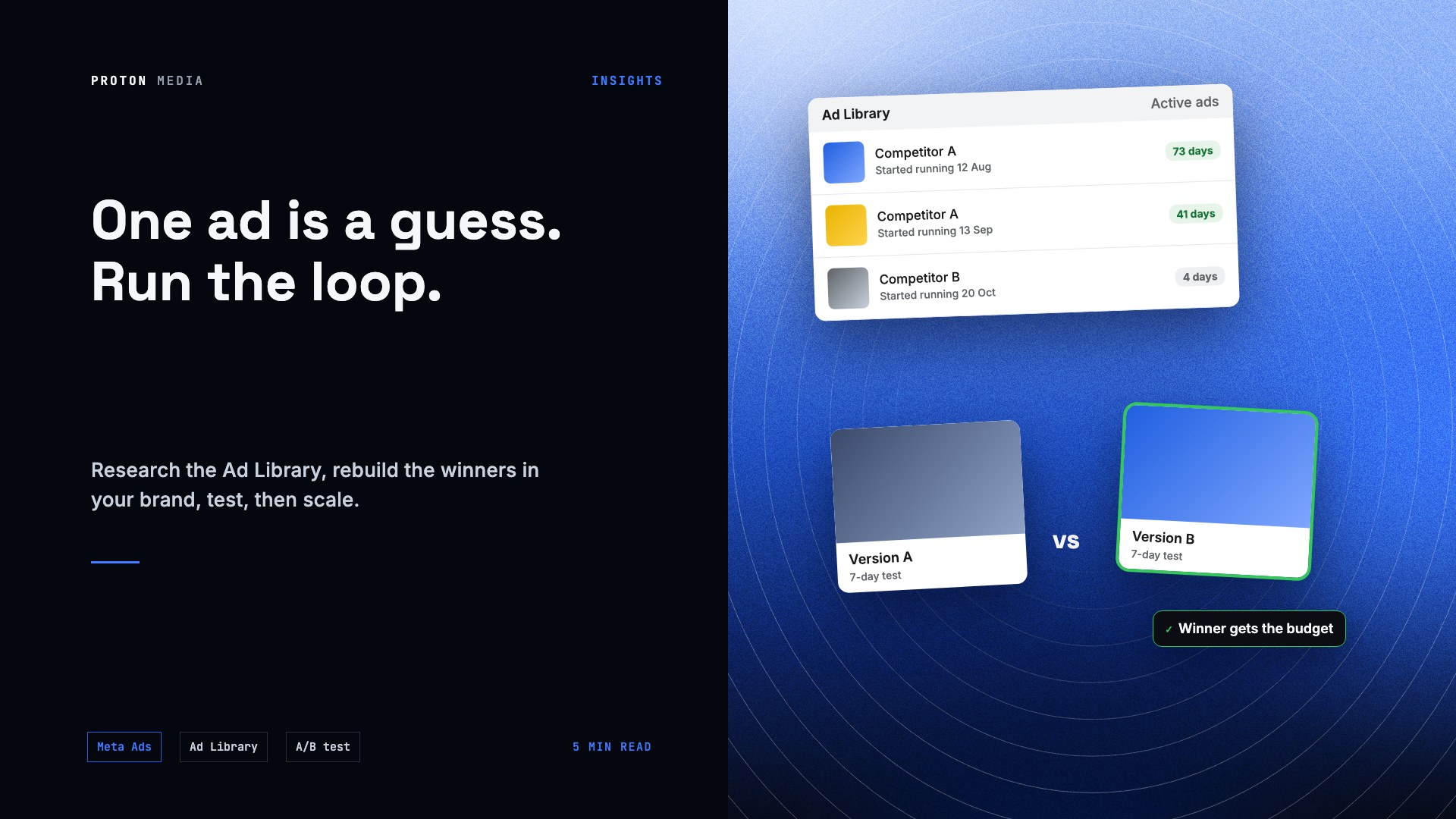
We run Meta ads as a loop instead. Research what is already working in your market, rebuild it in your brand, test the versions against each other, and put the budget behind the winner. Then do it again next month.
The loop in 60 seconds (voice-over in Bahasa Indonesia).
Step 1: Research in the Meta Ad Library
The Meta Ad Library is public. Anyone can search it, and it holds every active ad running across Meta’s apps. For each ad, it shows the date the ad started running.
That date is the signal we care about. Our working assumption: advertisers rarely keep funding an ad that loses money, so an ad that has been live for 30 days or more is one somebody keeps choosing to pay for.
It is a signal, not proof. For regular commercial ads outside the EU and UK, the library shows no spend and no reach, and nobody outside the advertiser sees the results. So we treat long-running ads as ideas worth testing, never as answers.
For each competitor, we pull:
- Every ad running 30 days or more
- The hook: the first line of copy, or the first three seconds of video
- The offer, and the kind of proof they lead with (testimonial, price, guarantee)
- The format: static, video or carousel
Step 2: Recreate it in your brand
We don’t copy ads. We take the angle (the problem, the promise and the type of proof) and rebuild it with your product, your voice and your visuals. The output is a set of statics, videos, hooks and copy variants, each one a test we can actually run.
This is where most of the work goes. Why the creative carries so much weight on Meta now is in creative is the new targeting.
Step 3: Test, then scale the winner
Meta’s built-in A/B test shows each version to a separate part of your audience, makes sure nobody sees both, and then reports which one performed best. Meta’s own guidance also warns against testing by switching ad sets on and off by hand, because that can lead to unreliable results.
We follow three of Meta’s rules:
- One variable per test. Meta says tests are more conclusive when the versions are identical except for the variable being tested.
- At least seven days. Meta recommends a minimum of 7-day tests, and a test can run for 30 days at most.
- One deciding number. For WhatsApp lead campaigns, that is cost per lead. (If you need a refresher on how CTR and CPM feed into it, see Meta Ads CTR, CPM and cost per result explained.)
The winner gets the budget and the losers get paused. Next month’s research feeds the next round of tests.
What this looked like on our own brand
Disclosure first: Faaza Travel is Proton Media’s in-house umrah brand. It sells umrah packages through WhatsApp, and we rebuilt its Meta click-to-WhatsApp campaigns in August and September 2026.
The problem. As spend scaled through 2026, lead costs climbed from Rp 27K per lead in January to Rp 67K in June. Monthly leads were stuck at 330 to 430, and August CPM reached Rp 165K. More budget was buying more expensive leads, not more jamaah.
What we changed.
- Audit before spending. We reviewed campaigns, placements and hour-by-hour results to find where the budget was leaking.
- Rebuilt the structure. Campaigns were split into always-on and tactical, with an audience ladder: lookalike 1%, 1–10%, 8–10%, broad and interest.
- Led with proof, not promos. A real jamaah testimonial video became the top creative. Fresh creative goes into the best-performing ad sets every month.
- Tracked every lead. Each campaign gets its own pre-filled WhatsApp message code, so every lead and every closing traces back to the ad that drove it.
- Scaled on a weekly rhythm. Weekly reports came with clear next actions, and the budget went up gradually, week by week.
The result (lead campaigns, from Meta Ads Manager):
| Jul 2026 | Sep 2026 | Change | |
|---|---|---|---|
| Ad spend | Rp 25M | Rp 44M | +76% |
| WhatsApp leads | 426 | 969 | +127% |
| Cost per lead | Rp 59K | Rp 46K | −22% |
| Click-to-message | 21.5% | 26.3% | +4.8 pt |
| CTR | 0.78% | 0.99% | +0.21 pt |
Across August and September, the ad cost per jamaah was Rp 1.27M, against an average revenue of Rp 49.7M per jamaah. That is a 39× return on ad spend. Those results include the sales team’s WhatsApp follow-up: the ads bring the conversation, people close the sale.
The part that isn’t finished. Frequency rose to 2.69 in September. That is the early warning for creative fatigue, so the October creative refresh is already going into the winning ad sets before it bites.
What the Starter package covers
If you want us to run this loop for you, Starter is Rp 5.5M a month:
- 4 static + 2 video ads a month
- Bottom-funnel lead campaigns
- Message-code lead tracking
- A weekly snapshot and a monthly report
- For ad spend up to Rp 20M a month
Ad spend is billed separately. There is a one-time Rp 2M setup and a 3-month minimum. Full details are on our Meta Ads service page (in Bahasa Indonesia).
Your move this week
Open the Meta Ad Library, search for your top competitor, and screenshot every ad that has been running for more than 30 days. That’s your test list.
Pick the one angle you haven’t tried yet, and test it against your current best ad: one variable, at least seven days, judged on cost per lead.
Want us to run the loop for you? Book a free 30-minute strategy call. We’ll look at your funnel and tell you what we’d actually do.